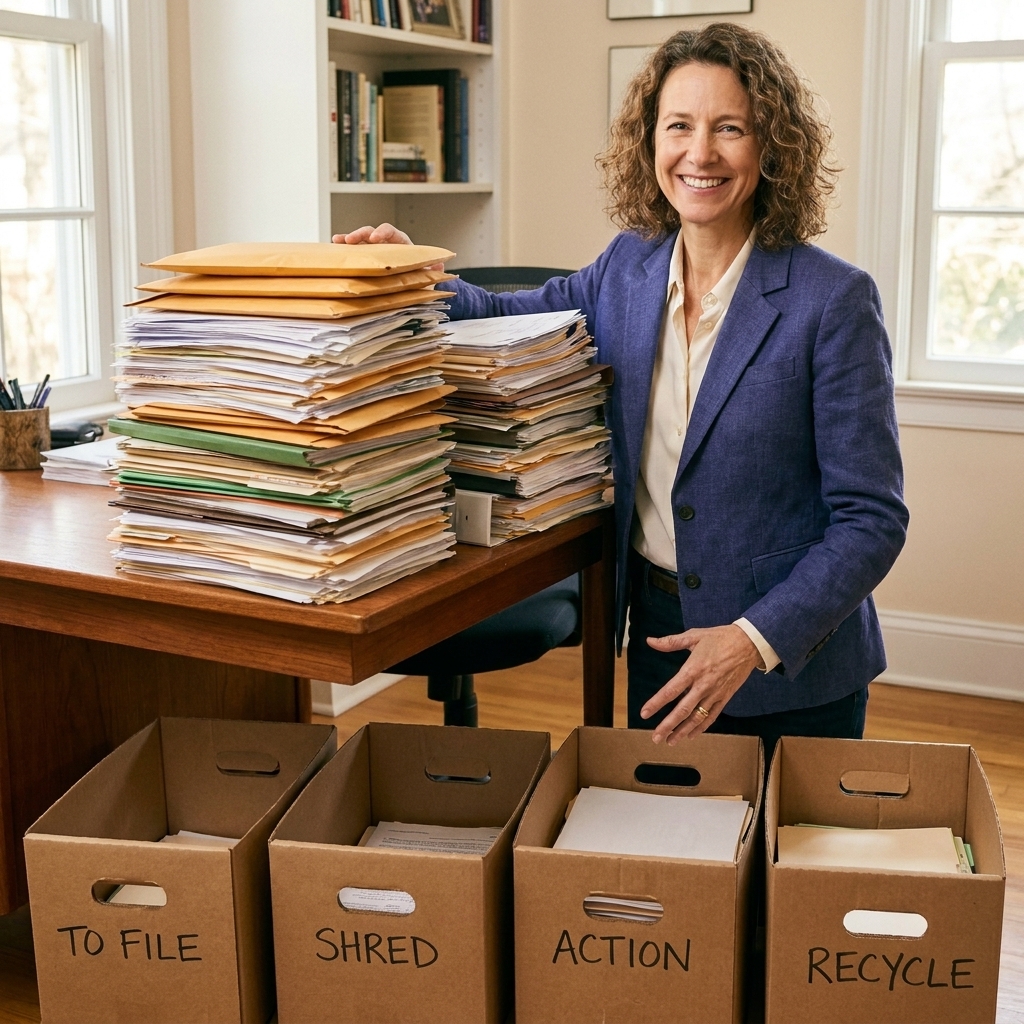
If paper clutter is your personal villain, you're not alone. Mail, permission slips, receipts, flyers, medical statements, random coupons you didn't ask for, it all walks into your house like it pays rent.
The Touch-It-Once Rule is the simplest system I've found for stopping those piles before they happen. The idea isn't to be perfect. The idea is to handle each piece of paper one time by making one clear decision and sending it to its next home, instead of setting it down “for later” and letting it multiply.
What it really means
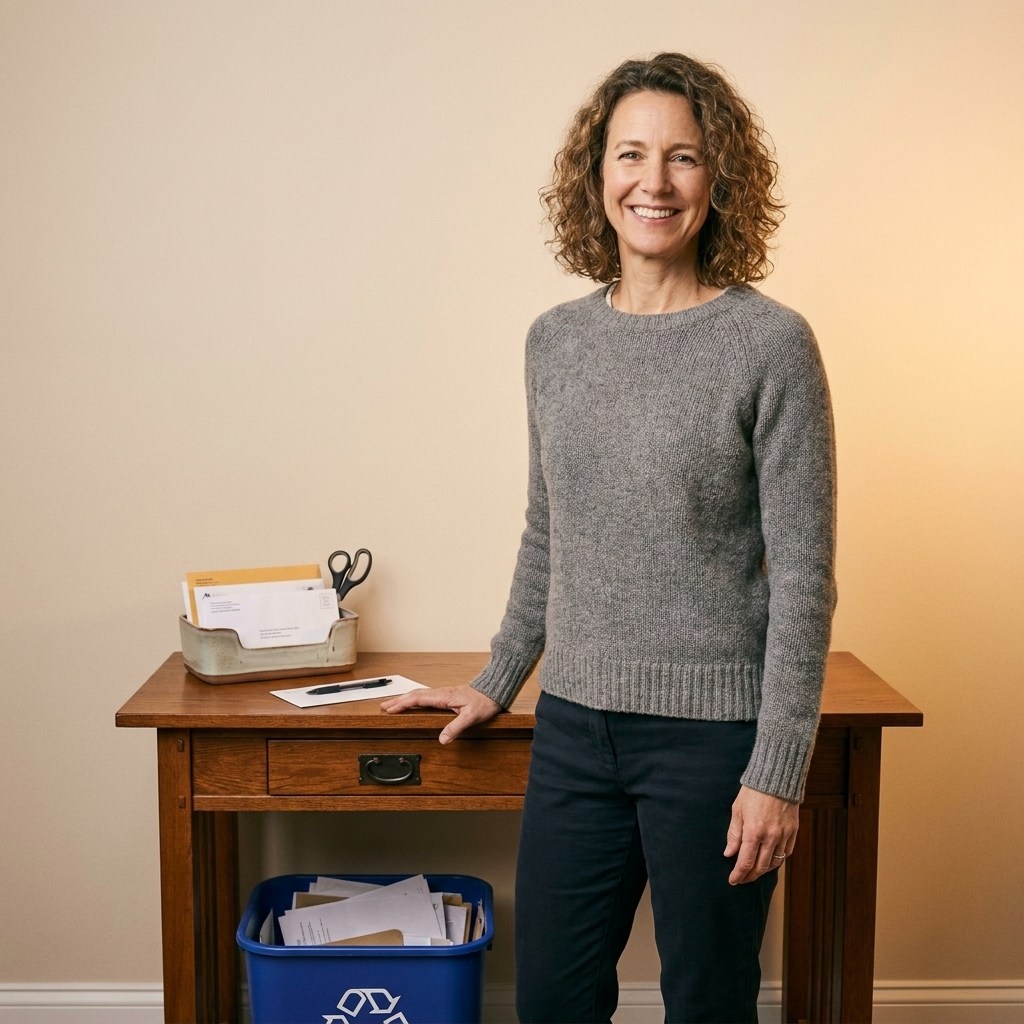
When you pick up a piece of incoming paper, you don't set it down again until you've decided its next home.
- Trash or recycle it.
- File it.
- Act on it (pay, sign, RSVP, scan, schedule).
- Put it in one designated “Action” spot if the task can't be done in two minutes.
This rule is less about speed and more about eliminating the “temporary pile” stage. Temporary piles become permanent roommates.
Set up a small station
This doesn't need to be a Pinterest command center. Mine started as a shoebox lid and a pen that worked.
Put it where paper enters
Choose one location: entryway table, kitchen counter corner, or the spot where backpacks get dumped.
Use a simple 4-part system
- Recycle bin: a small bin or bag right there, not across the house.
- Shred (sensitive): an envelope or lidded container for anything with account numbers or medical info.
- Action tray: one upright file or tray for time-sensitive items.
- File folder: one folder for “keep” papers until filing day.
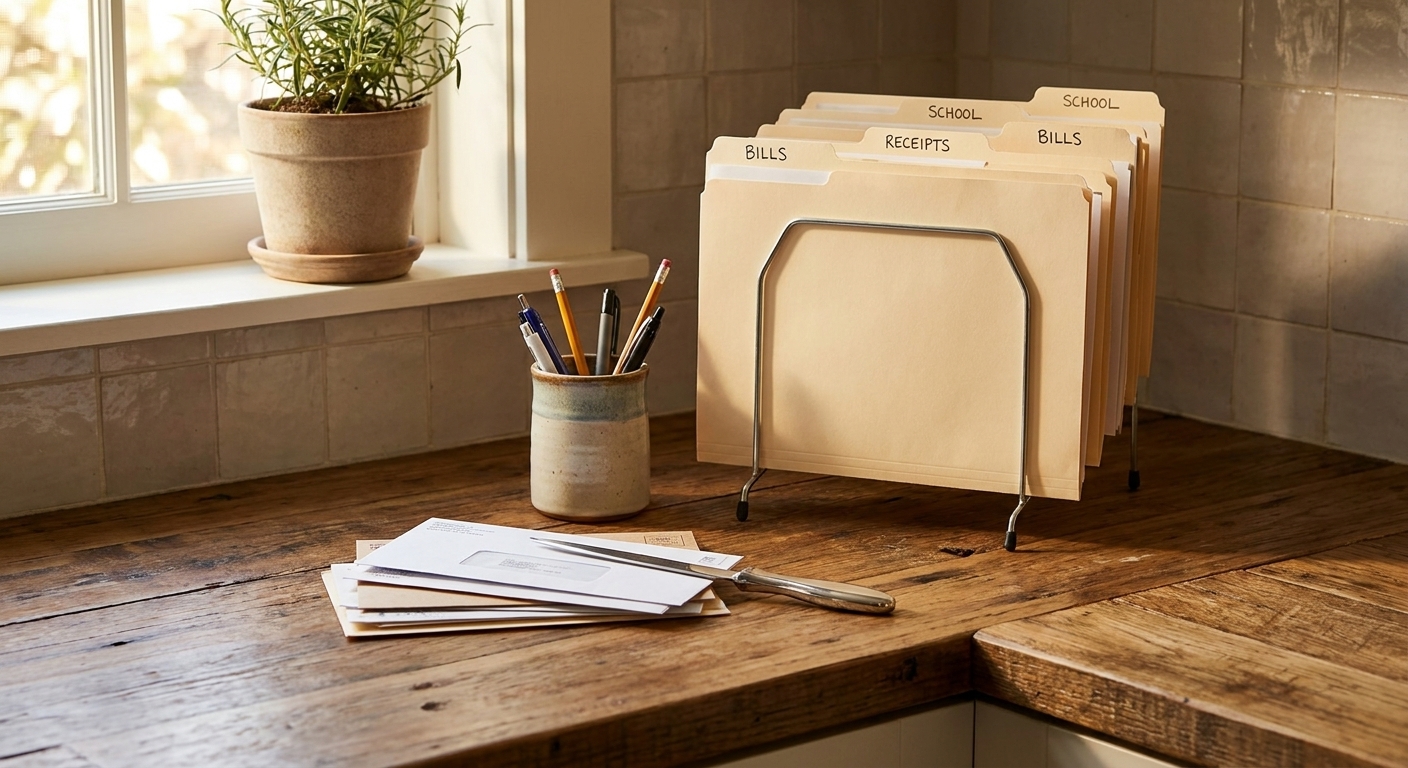
Add two tools and you're done: a pen and scissors or a letter opener. Optional but life-changing: a small stapler for keeping multi-page school packets together.
Daily routine (5 minutes)
I like to do this as part of my “walk in the door” or “after dinner” rhythm. The timing matters less than the repetition.
Step 1: Open it
Unopened envelopes are sneaky clutter. Open what's legitimate and safe to open and what you plan to keep or act on. If something looks suspicious or you might need the envelope intact, set it aside in your Action tray until you can verify it.
Step 2: Sort into four decisions
- Toss: junk mail, flyers, duplicate school handouts, envelopes.
- Shred: anything with personal info you don't need to keep.
- Act: items that take two minutes or less.
- File: keepers that aren't actionable.
Step 3: Do the two-minute actions
Examples: sign the reading log, initial the field trip form, add the appointment card to your calendar, write the check, take a photo of the flyer with a date.
If it'll take longer than two minutes, it goes in the Action tray. That's still Touch-It-Once, because you made the decision once: this paper lives in the Action tray until your next admin block.
Step 4: Clear the surface
End with an empty or mostly empty landing zone. Visual calm is the reward that makes the habit stick.
School papers
School paper is a different species. It arrives daily, it's emotionally loaded, and it loves to live on the kitchen counter forever.
Create a checkpoint
Before backpacks go to bedrooms, papers come out. Even if you're tired. Even if you do it badly. This one change prevents the surprise crumpled permission slip two minutes before bedtime.
Use three kid-friendly categories
- Need-to-sign: permission slips, behavior forms, anything with a due date.
- Need-to-know: calendars, flyers, newsletters.
- Kid keeps: artwork or graded work they care about.
Put “Need-to-sign” straight into your Action tray. “Need-to-know” gets one quick choice: add the date to your calendar or recycle it. “Kid keeps” goes into a single folder or bin per child.
Let a container set the limit
My favorite boundary is a one-bin rule: each child gets one lidded bin or one magazine file for the current school year. When it fills up, you do a quick swap-out together. The container is the limit, not your guilt.

Filing basics
Filing is where good intentions go to die because we think it has to be elaborate. It doesn't.
Start with three folders
- Household: manuals, warranties, home-related receipts you keep.
- Medical: insurance letters, visit summaries, vaccination records.
- Taxes: anything clearly tax-related.
If you stop there for now, you'll still be miles ahead of the “mystery pile by the microwave” era.
Use an Active folder
Keep a single folder or thin accordion file for items you might need soon: current school schedule, team info, ongoing project receipts, paperwork you're waiting to hear back about.
Once a month, either move items into long-term folders or recycle them.
Keep or toss
If you freeze up and end up making a pile, it's usually because you're unsure what's safe to toss. Here are realistic guidelines that work for most households. Requirements vary by country, employer, insurer, and tax authority. When in doubt, check the rules that apply to you.
Usually toss or recycle
- Catalogs and generic store flyers you won't use this week
- “Resident” offers and credit card solicitations (shred if they include identifying info)
- School newsletters once you've saved key dates
- Packaging inserts and duplicates
Usually file short-term (then purge)
- Paid bills and statements you want to keep until you confirm everything clears
- Receipts for returns or reimbursements
- Appointment summaries until follow-ups are done
Usually file long-term
- Tax documents and supporting paperwork
- Home purchase documents and major appliance warranties
- Insurance policies and claim paperwork
- Vital records originals and certified copies (store in a secure spot)
Don't miss the urgent stuff
Some papers shouldn't sit in a tray for a week. If you see anything time-critical or high-stakes, bump it to the front of the line and handle it the same day.
- Jury duty notices
- Tax letters or notices from government agencies
- Medical bills, appeals, or anything with a deadline
- Insurance cancellation notices
- Past-due utility notices
If it helps, make a simple rule: if it has a deadline or threatens a service, it becomes a two-minute action (calendar it, pay it, call, or send it to the right person) right now.
Weekly reset (15 to 30 minutes)
Even with Touch-It-Once, real life happens. The weekly reset is your safety net.
Put it on repeat
Pick a low-drama time, like Sunday afternoon or Friday morning. Set a timer.
Quick checklist
- Empty the Action tray: pay, sign, scan, schedule, reply.
- File the File folder contents.
- Take out recycling and your shred pile.
- Clear backpacks and lunchbox notes.
If you're a fellow reformed messy person, keep this rule: done is better than filed perfectly. Progress is the goal.
Troubleshooting
“My partner keeps making a pile.”
Make the system easier than the pile. Put the recycling bin and Action tray in the most obvious place, and label the tray. If your household will tolerate it, do a 60-second daily handoff: “Anything you need me to sign?” Then it goes back to the station.
“I don't have time every day.”
Then make it smaller: two minutes. Open, toss junk, and put everything else in Action or File. That's still a win, and it keeps the pile from becoming a weekend-long project.
“I'm drowning in papers already.”
Start by creating a temporary Paper Triage Box. Put every loose paper pile into one box. Then begin Touch-It-Once for all new incoming paper today. Once the bleeding stops, you can process the triage box in short sessions.
“I want to go paperless, but it never sticks.”
Paperless works best when you do it selectively. Switch recurring bills and statements to digital first. Keep a small scanning habit for truly important items, like school certificates you want to save without storing.
If you scan, keep it simple: one cloud folder called “Household Paperwork,” then subfolders like “Taxes,” “Medical,” and “Home.” Name files like 2026-04 Dentist bill so they're searchable. Also, remember that some originals still matter (vital records, certain legal documents), so don't assume a photo replaces everything.
Reduce what comes in
The fastest way to win at paper is to get less of it.
- Unsubscribe from retail mailers and catalogs you never use.
- Go paperless for bills and statements that you don't need in hard copy.
- In the U.S., consider opting out of prescreened credit offers if that fits your situation.
Starter kit
- One tray or vertical file holder
- One folder labeled “File”
- One folder labeled “Active”
- One envelope or lidded container for “Shred”
- Pen, scissors or letter opener
- Recycling bin within arm’s reach
That's it. No label maker required. You can absolutely add clear acrylic bins later if that's your love language, but the habit comes first.
FAQ
Does Touch-It-Once mean I have to finish every task immediately?
No. It means you decide the next home for that paper immediately. If you can't handle it now, it goes into one Action spot, not five random surfaces.
How many Action spots are allowed?
One. If you have two, you'll have zero, because you'll forget which pile is the real pile.
What if my kids bring home a mountain every day?
Lower the bar and standardize the flow. Same checkpoint, same categories, same Action tray. Consistency beats intensity here.
Should I shred everything?
Shred what contains sensitive information. Otherwise, recycling is faster and totally fine. If shredding becomes the bottleneck, you'll start avoiding the whole routine.
The goal
The Touch-It-Once Rule isn't about becoming a different person. It's about building a tiny system that supports the person you already are, tired, busy, and trying to keep the household moving.
Start today with one tray, one recycle bin, and one promise to yourself: paper doesn't get to “rest” on your counters anymore. It gets handled, once.