
If you have a few spots in your home that magically reset to messy every couple of weeks, you are not failing. Your system probably is. (Ask me how I know.)
A monthly organization audit is my formerly-messy secret weapon: 30 to 60 minutes to check the areas that keep sliding off the rails, figure out why, then make tiny adjustments so the space stays easy on a normal Tuesday, not just right after a deep clean.

This is not a whole-house overhaul. It is a quick, repeatable check-in that helps you keep the systems that work and tune the ones that do not.
What a monthly organization audit is
A monthly audit is a short, scheduled review of your storage zones to answer three questions:
- What keeps getting messy again?
- What is causing the mess? (Not morally. Mechanically.)
- What one tweak would make “putting it away” easier than “dropping it”?
The goal is not perfection. The goal is reducing friction so your home naturally returns to baseline with less effort.
Set up your audit fast
Pick 3 zones, not the whole house
Start with the places that annoy you the most or cause daily stress. My usual repeat offenders:
- Entryway drop zone (shoes, backpacks, mail)
- Kitchen counter hot spot
- Pantry snack shelf
- Bathroom vanity drawer
- Laundry landing zone (chair, anyone?)
- Kids’ craft or homework area
Choose a consistent day
I like the last weekend of the month, right before my Sunday reset. But any repeatable anchor works: first Saturday, paycheck weekend, the day before trash pickup.
Grab a tiny “audit kit”
- Trash bag
- Donate bag or box
- Microfiber cloth
- Marker and a roll of painter’s tape (for temporary labels)
- One empty bin or basket (for collecting roamers)
The 7-step monthly audit
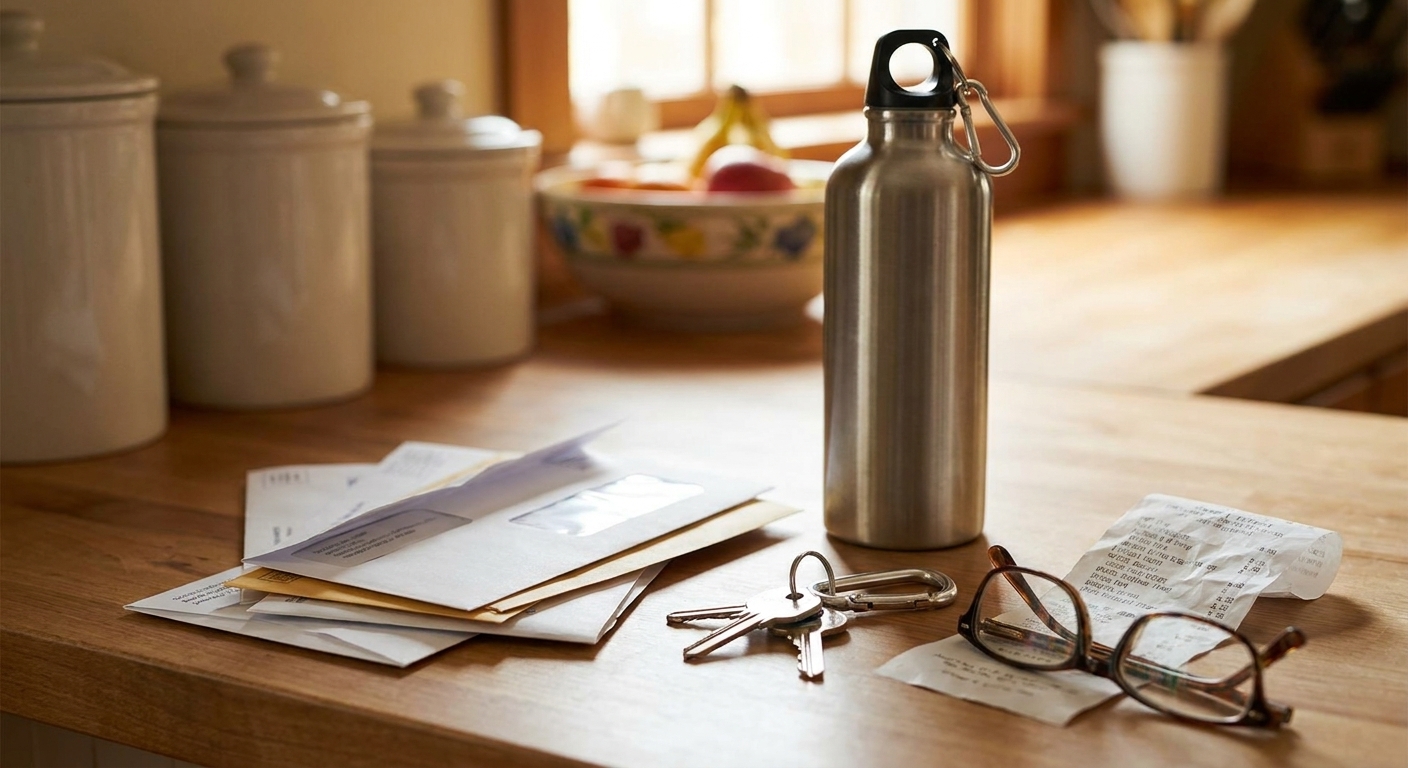
Step 1: Take a 10-second “mess photo”
This sounds silly, but it helps you see patterns. A month from now, you will be able to tell if the same category keeps exploding or if the clutter is shifting.
Step 2: Clear the surface and sort into 4 piles
- Keep here (this zone is the right home)
- Elsewhere (right item, wrong home)
- Trash
- Donate
Do not reorganize yet. Just get visual clarity.
Step 3: Name what this space is for (one sentence)
Every storage area needs a job description. If a zone is trying to do five jobs, it often starts to break down.
- Entry basket: “This holds today’s in-and-out items only.”
- Pantry bin: “This holds grab-and-go school snacks.”
- Bathroom drawer: “This holds daily getting-ready essentials.”
Step 4: Identify the failure type
In my experience, messy-again spaces fail for predictable reasons. Find yours:
- Too far: The storage is not where the action happens.
- Too hard: Lids, stacking, complicated steps, or tight fits.
- Too small: The container cannot realistically hold the category.
- Too big: The container invites overstuffing and “miscellaneous.”
- Unclear: No one knows where things go, including you at 9:30 p.m.
- One-way flow: Easy to take out, annoying to put back.
- No buffer: There is no landing spot for in-between items.
Step 5: Look for the true clutter category
Clutter is often a category that does not have a proper home, like:
- Incoming paper
- Chargers and cords
- Water bottles
- Hair tools
- Kids’ small toys
- Reusable bags
- Returns and “need to take upstairs” items
If the same category shows up every audit, stop blaming yourself and build a home for it.
Step 6: Make one tweak using the “easier than dropping it” rule
Ask: What would make putting this away take about 10 seconds or less? Pick one change, not ten.
- Swap a lidded bin for an open bin.
- Move the basket closer to where items land.
- Add drawer dividers so categories stop blending.
- Right-size the container (bigger for bulky, smaller for tiny).
- Create a small buffer bin labeled “Elsewhere” for roamers.
One quick safety note: if you switch to open bins, keep medications, sharp tools, and other hazardous items secured and out of kids’ reach.
Step 7: Finish the loop (5 minutes)
Set a 5-minute timer and deal with your Elsewhere pile. Walk items to their real homes, or drop them into one small “Put Away Basket” for your next weekly reset.
Then write a two-line “reset instruction” for Future You. Use painter’s tape on the inside of a cabinet door or on the bottom of a bin. Example:
- Snack bin reset: Toss expired items. Refill from overflow shelf. Keep 2 days of variety.
- Entry reset: Shoes on rack. Mail to file tray. Return backpacks to hooks.
It is not aesthetic, but it is effective. You can upgrade later.
Troubleshoot a failing system
Here are the most common problems I see in real homes (including mine), plus fixes that do not require a full remodel.
Problem: The bin is always overflowing
Likely cause: The category is bigger than the container, or you are storing two categories together.
Try:
- Split into two bins (example: “chips” and “bars”).
- Add an overflow backstock spot so the daily bin stays breathable.
- Set a simple cap: “If it does not fit, we do not buy more until it does.”
Problem: Items pile up right next to the storage
Likely cause: The storage is slightly annoying to use.
Try:
- Remove lids.
- Lower the shelf.
- Use a wider bin so it does not require perfect placement.
- Switch from stacking to single-layer when possible.
Problem: The system works for you but not for everyone else
Likely cause: The system requires mind-reading or too many steps.
Try:
- Make it more obvious: open bins, front-facing baskets, clear containers.
- Reduce choices: fewer categories, broader labels.
- Put the most-used items at hand height.
Problem: The space looks organized but feels stressful
Likely cause: Visual clutter or decision fatigue.
Try:
- Group like-with-like and remove duplicates.
- Use one style of bin per zone (my weakness is clear acrylic).
- Hide the truly messy categories behind a door, but keep the system simple inside.
Problem: You keep “relocating” things instead of putting them away
Likely cause: You need a buffer.
Try:
- Create a small “Put Away Basket” for each floor.
- Empty it during your weekly reset, not every day.
- Keep it intentionally small so it cannot become a second storage unit.
Mini audits for trouble spots
Entryway: stop the daily pile
Audit questions:
- Do shoes have a real cap, or do they multiply at the door?
- Is there a hook for every backpack and jacket actually used?
- Is mail landing because there is no paper system?
Easy tweaks:
- One shoe rack plus one small overflow basket for the week.
- Hooks at kid height, not just adult height.
- A two-slot tray: “To deal with” and “To file.”
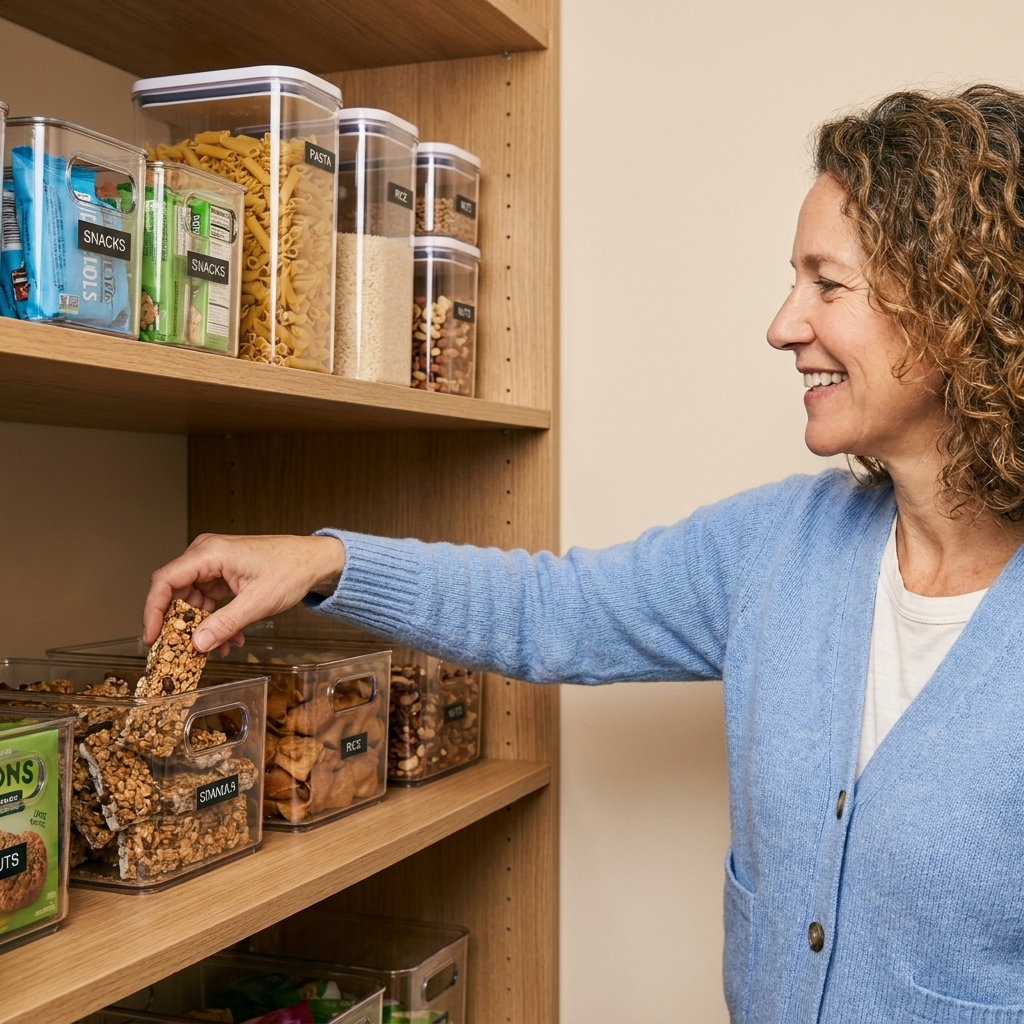
Pantry: the snack shelf that implodes
Audit questions:
- Are snacks stored by type or by chaos?
- Is backstock mixed into the daily grab zone?
- Do you keep buying because you cannot see what you have?
Easy tweaks:
- Open bins for categories, not individual items.
- A separate backstock bin up high.
- One “use first” bin at eye level for soon-to-expire food.
Bathroom: the drawer that becomes a junk drawer
Audit questions:
- Is this drawer holding daily items or everything you own?
- Are small items rolling around because there are no dividers?
- Do you have duplicates you do not use?
Easy tweaks:
- Cheap drawer dividers to create lanes for categories.
- A small cup for cotton swabs and hair ties.
- Move backups to a separate bin so the daily drawer stays simple.
Laundry zone: the clean-clothes limbo problem
Audit questions:
- Do you have a place for clothes that are clean-ish and will be worn again?
- Is folding the step that breaks the system?
Easy tweaks:
- Add a hook row for re-wear items.
- Use one basket per person for clean clothes if folding is not happening.
- Store socks and underwear in simple open bins if drawers are a bottleneck.
Monthly audit checklist
- Choose 3 zones to audit this month.
- Take a quick photo of each zone.
- Empty and sort into: Keep here, Elsewhere, Trash, Donate.
- Write the zone job description in one sentence.
- Identify the failure type (too far, too hard, too small, unclear, no buffer).
- Choose one tweak that removes friction.
- Set a 5-minute timer and clear the Elsewhere pile.
- Add a two-line reset note for Future You.
- Schedule next month’s audit date.
How to tell it worked
Give your tweak a week or two as a starting point. Then check for these signs:
- You can put items away one-handed and half-asleep.
- Other people in the house use the system without being reminded.
- The mess is smaller and slower to return.
- Your weekly reset takes less time in that zone.
If it is not working, that is still a win. You gathered data. Adjust one variable and test again.
FAQ
How long should a monthly organization audit take?
For three zones, aim for 30 to 60 minutes total. If you hit 90 minutes, you probably chose too many areas or slipped into deep-cleaning mode.
What if I do not have storage budget for fixes?
Most effective fixes are free: remove lids, move items closer to where they land, reduce steps, and right-size by editing the category. When you do buy something, start with inexpensive drawer dividers or one sturdy open bin.
Do I need labels?
Not always, but they help when multiple people use the space. Temporary painter’s tape labels are perfect during the testing phase.
What if I rent or have tiny closets?
Focus on friction, not square footage. Open bins, vertical hooks, and a small buffer basket can transform a tiny space because the system matches how you actually move through the room.
A final note from a formerly messy person
If your house keeps getting messy in the same places, it is not a character flaw. It is a design problem. A monthly organization audit lets you fix the design one small tweak at a time, until your home feels calmer without you working overtime to keep it that way.
Pick three zones, set a timer, and give yourself permission to keep it practical. Peaceful beats picture-perfect every single month.